
The 80-20 Rule in Poker: How the Pareto Principle Increases Your Win Rate

By Don • Last updated February 23, 2026
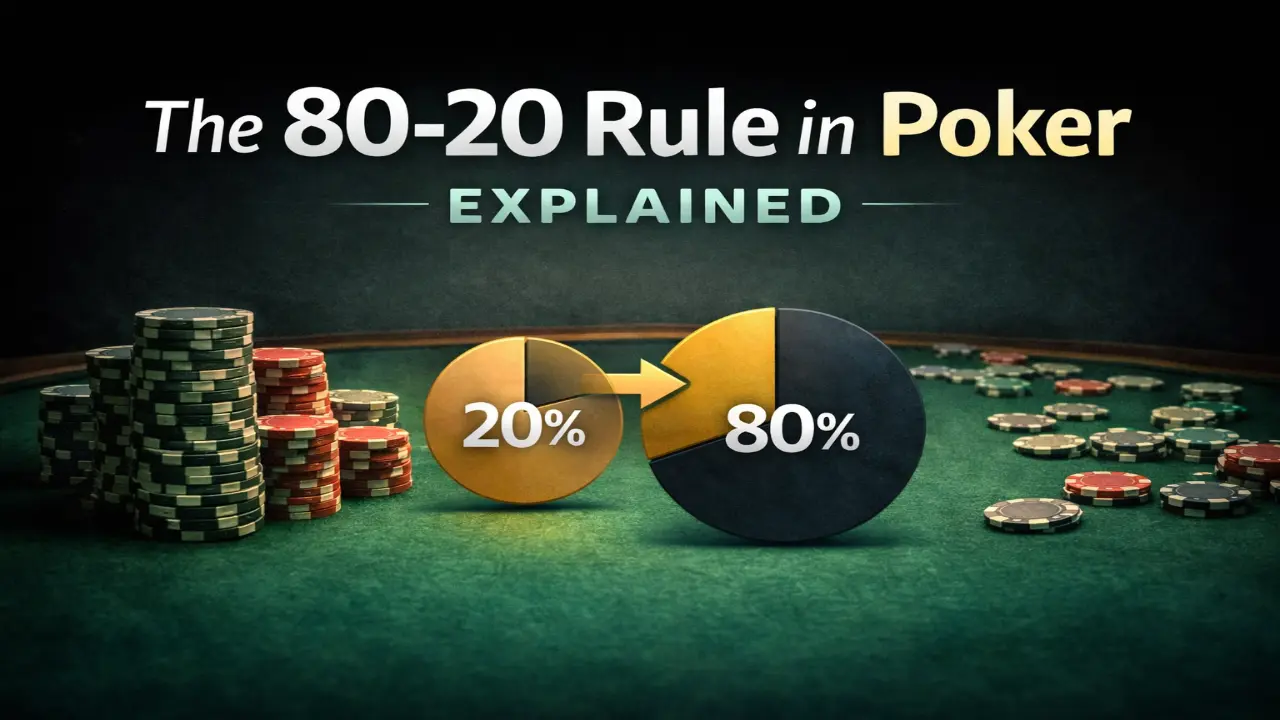
Learn how the 80-20 rule in poker (Pareto Principle) can improve your win rate. Discover how 20% of hands, spots, and opponents generate 80% of your profits, as well as how to exploit it.
What Is the 80-20 Rule in Poker?
The 80-20 Rule or Pareto Principle States that 80% of Results Come From 20% of Causes

The 80-20 Rule in poker is an application of the Pareto Principle, first observed by Italian economist Vilfredo Pareto in the late 19th century. Pareto discovered that roughly 80% of the land in Italy was owned by just 20% of the population, a pattern of imbalance that appeared repeatedly in economics and society. Decades later, management consultant Joseph M. Juran popularized the concept in business, describing it as the difference between the “vital few and the trivial many.”
It is not a strict mathematical law and the numbers are not always exactly 80 and 20. Sometimes the distribution may look closer to 70/30 or 90/10. The principle simply highlights that in many competitive systems, a minority of inputs produce a majority of outputs, including decisions, hands, opponents, and study time in poker.
In poker, this often looks like:
- A small group of weaker players generating most of your profit
- A small percentage of hands producing most of your expected value
- A few high frequency spots determining most of your results
- A handful of leaks causing the majority of your losses
Understanding this imbalance allows you to focus your time, study, and attention on the areas that actually move your win rate instead of trying to master every situation equally.
How the 80-20 Rule Shows Up in Poker
| Jump to Each 80-20 Example | |||
|---|---|---|---|

80% of Profit From 20% of Players |

80% of EV From 20% of Hands |

80% of Results From 20% of Spots |

80% of Losses From 20% of Leaks |
The 80-20 principle is not just theory. It shows up clearly in real poker results, databases, and long term win rates. When you analyze where your money actually comes from, you will usually find a strong imbalance.
80% of Profit Comes From 20% of Players in Poker
In most games, a small percentage of recreational players generate the majority of the profit in the pool. Strong regulars often battle each other close to break even, while weaker players make consistent strategic mistakes that create long term edge.
This is why table selection is one of the highest impact skills in poker. Choosing better games often increases your win rate more than learning an obscure solver line.
80% of Your Expected Value Comes From 20% of Hands in Poker
Premium holdings such as strong pairs and high equity combinations generate a disproportionate amount of long term expected value. Marginal hands make up a large portion of the volume you play, but they rarely contribute as much profit.
This does not mean you should ignore balanced ranges. It means you should understand which hands truly drive your win rate and avoid overvaluing marginal spots.
80% of Results Come From 20% of Spots in Poker
High frequency situations such as single raised pots, blind versus blind battles, and continuation bet decisions occur far more often than rare multiway river nodes. Because they happen so frequently, they contribute heavily to your overall results.
Studying the most common situations often produces far greater improvement than spending hours on rare theoretical spots.
80% of Your Losses Come From 20% of Leaks in Poker
Just as profits concentrate, so do mistakes. A small number of recurring leaks such as calling too wide out of position, over bluffing in poor textures, or making emotional decisions under pressure can account for most of your losses.
Identifying and fixing these high impact mistakes is one of the fastest ways to improve your long term win rate.
How to Apply the 80-20 Rule in Your Poker Study

Understanding the 80-20 rule is useful. Applying it correctly is what increases your win rate. The key is to identify the small number of adjustments that create the largest improvement in your results.
Focus on High Frequency Situations in Poker
Single raised pots, blind versus blind battles, common continuation bet spots, and standard 3bet pots occur far more often than rare multiway river scenarios. Because they make up a large percentage of your volume, even small improvements in these areas compound over time.
Mastering the most common situations gives you far greater return on study time than trying to memorize low frequency solver branches.
Fix Your Biggest Leak First

Review your database and identify where you are losing the most money. Filter by position, stack depth, or specific situations. Often one recurring mistake accounts for a significant portion of your losses.
Correcting a single high impact leak can improve your win rate faster than adding new advanced strategies.
Prioritize Poker Game Selection

Not all tables are equal. If a small percentage of players generate most of the available profit, your ability to choose better games becomes a direct edge.
Strong strategy matters, but playing in softer environments often has an even greater effect on your long term results.
Common Misunderstandings About the 80-20 Rule

The 80-20 rule is a powerful concept, but it is often misunderstood. Applying it incorrectly can lead to oversimplified thinking or strategic laziness.
It Is Not Always Exactly 80 and 20 in Poker
The ratio is not fixed. In some games it may be closer to 70/30 or 90/10. The principle simply highlights that results are usually unevenly distributed.
The goal is to recognize imbalance, not to force the numbers to fit a specific percentage.
It Does Not Mean You Should Ignore Small Edges in Poker
Poker is still a game of small advantages. Even low frequency spots can add up over large samples. The 80-20 rule encourages prioritization, not neglect.
Once you master the highest impact areas, refining smaller edges becomes valuable.
It Is Not an Excuse to Avoid Studying Poker Game Theory
The principle is about efficient effort, not reduced effort. Strong players still study deeply. They simply focus their attention on areas that provide the greatest return on time invested.
Work smarter, but still work.
80-20 Rule vs GTO: Are They Opposites?
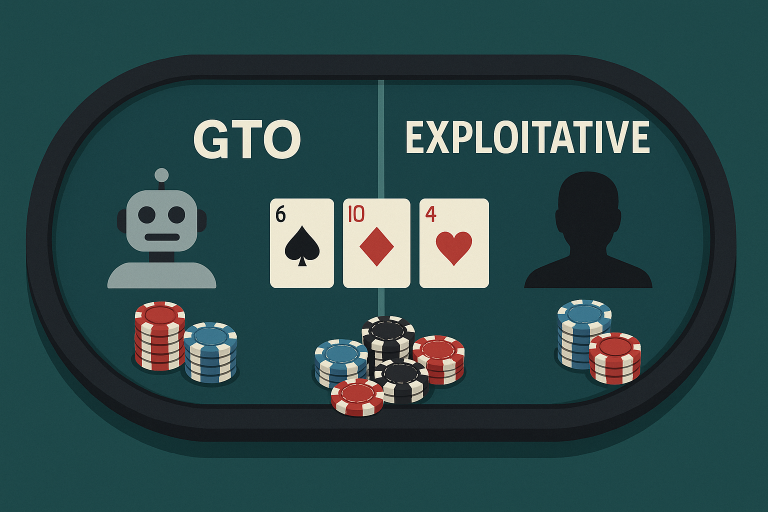
At first glance, the 80-20 rule and GTO strategy may seem like opposites. GTO aims to build a complete, balanced strategy that covers every possible situation. The 80-20 rule focuses on prioritizing the situations that matter most.
GTO Covers Everything in Poker
Game Theory Optimal strategy attempts to create a balanced approach across all nodes, bet sizes, and runouts. It aims to make you unexploitable over the long term.
This requires understanding a wide range of scenarios, including many that occur infrequently.
The 80-20 Rule Prioritizes What Drives Results in Poker
The 80-20 mindset does not reject balance. Instead, it recognizes that certain spots, opponents, and mistakes contribute more heavily to your win rate.
For example, improving your strategy in common single raised pots will usually impact your results more than memorizing rare multiway river solver branches.
Strong Poker Players Combine Both GTO and the 80-20 Rule in Poker
The most successful players understand GTO fundamentals while applying the 80-20 principle to guide their study and game selection.
They build solid theoretical foundations, then focus their time and attention on the areas that generate the majority of their edge.
How the 80-20 Rule Improves Your Poker Win Rate

The 80-20 rule in poker is ultimately about improving your win rate through smarter focus. Instead of spreading your attention evenly across every possible scenario, you prioritize the decisions, spots, and opponents that generate the majority of your results.
By concentrating on high frequency situations, fixing your largest leaks, and selecting profitable games, you accelerate your improvement and reduce wasted effort.
Poker rewards precision, not volume of knowledge alone. When you align your study strategy with the Pareto Principle, you increase efficiency, sharpen your edge, and build a stronger long term foundation.
Master the vital few. Let the trivial many take care of themselves.












Leave a Reply