
Is Poker Luck or Skill? | Skill vs Luck Ratio in Poker

By Don • Last updated February 9, 2026
Is poker skill or luck? Read on to learn why poker isn’t skill vs luck, but a game where the skill to luck ratio includes luck in its percentage from understanding odds, math, and variance.
Is Poker a Game of Skill or Luck?
Not Luck vs Skill, Skill = Luck in Poker
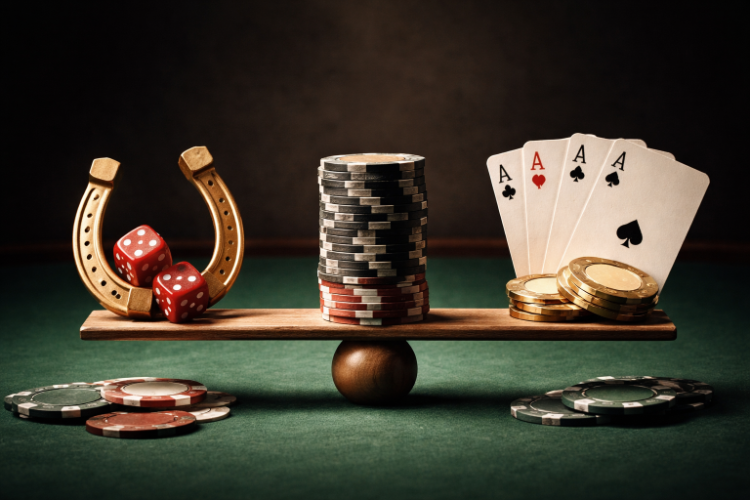
Poker isn’t about skill beating luck. It’s about skill understanding luck.
Every hand of poker is a math problem disguised as a card game. When you decide whether to call, fold, or raise, you’re really asking: What are the odds, and is this decision profitable given how often I’ll win or lose? That calculation is the bridge between skill and randomness.
This is where the question “is poker skill or luck?” starts to fall apart. The skill in poker comes from knowing how likely certain outcomes are and choosing actions that make money over time even though any single result can go either way.
Think of it like weather forecasting. You can’t control whether it rains tomorrow, but you can look at probabilities and decide whether to bring an umbrella. Poker works the same way. You won’t always be right, but making the right decision more often than not is what defines a skilled player.
This is also why weaker players sometimes win games or even entire tournaments. They benefit from the same randomness they just don’t understand it. Strong players accept that luck will swing both ways and focus on consistently putting themselves in good spots.
So poker isn’t skill versus luck. Poker skill is the ability to work with luck, manage it, and let the math do its job over time.
Poker Skill to Luck Ratio
The Ratio of Luck to Skill in Poker Diminishes the Longer the Time Frame is.
One of the most common follow-up questions players ask after debating poker skill vs luck is: “Okay, but what’s the ratio?” How much of poker is skill, and how much is luck?
It’s an understandable question, people want a number. A percentage. Something concrete they can point to. The problem is that poker doesn’t work that way.
There is no fixed poker skill to luck ratio that applies to every hand, every session, or every player. The balance between skill and luck changes depending on time frame, sample size, and decision quality. That’s why two players can experience wildly different results while playing the same game.
In a single hand, luck dominates. In a single session, luck still has a lot of influence. But as the number of hands increases, skill starts to matter more and more. The cards stay random, the decisions don’t.
This is why short-term results are such a poor measure of how good someone actually is at poker.
Skill vs Luck Percentage
You’ll see this argument all the time online: people trying to put a number on poker, saying things like “it’s 70% skill” or “nah, it’s basically 50/50.” It sounds confident, but those numbers don’t actually tell you much on their own.
Poker feels very different depending on how much you’ve played. If you sit down for ten hands, luck is going to feel like it’s running the show. Play for a few sessions, and it still feels chaotic. But once you zoom out to thousands of hands, the noise starts to fade and patterns begin to show. Keep going long enough, and the players making better decisions almost always end up ahead.
That’s why experienced players don’t tilt over short-term swings. They expect them. They know that losing with the best hand or getting there with the worst one is just part of the deal. Their edge doesn’t come from trying to win every pot it comes from consistently making choices that are slightly better than the people they’re playing against.
A simple way to think about it is this:
Luck controls what cards come out. Skill controls what you do with them.
Weaker players lean on luck without even realizing it. Strong players accept that it’s there and factor it into every decision. The best players build their entire approach around that randomness and trust that, over time, the math will take care of the results.
So when someone asks for a clean skill-to-luck ratio in poker, the real answer isn’t a percentage. It’s a time frame. The longer you play, the more skill has room to show.
The Evolution of Skill in Poker

Poker hasn’t always been played the way it is now. For a long time, most decisions came down to instinct. Players trusted their gut, tried to “feel out” opponents, and relied heavily on live reads. Some of that still matters, but back then there wasn’t much structure behind the choices people were making.
That started to change once poker moved online. Suddenly players could see thousands of hands instead of just remembering the big pots. Patterns became obvious. Certain plays kept winning money, and others kept losing it regardless of who was getting lucky in the short term. Modern GTO emerged from this quickly overtime. Now almost all professional players rely heavily on game theory optimal, although it may not feel like it, as the majority of amateur players who try to use GTO, tend to skew heavily away from it.
This is where the idea of poker being mostly luck began to crack. Players who paid attention to odds, bet sizing, and long-term results started pulling away from the field. Not overnight, and not in every session, but steadily. The more hands you looked at, the harder it was to argue that results were random.
Another big shift was accountability. In the past, you could blame bad runs on luck forever. Today, large sample sizes don’t let you hide. If you’re consistently making poor decisions, it shows. If you’re making good ones, that shows too eventually.
What’s important is that the game itself didn’t change. The cards are still random. Bad beats still happen. The difference is that players now understand what those beats actually mean. They don’t see them as proof that poker is unfair, they see them as part of the system.
As poker skill evolved, so did the players. Fewer guesses, fewer emotional decisions, and more trust in the math behind the game. That’s why modern poker feels tougher than it used to.
The Evolution of Skill in Poker

To be fair, anyone claiming that luck doesn’t matter in poker is ignoring reality. Luck is real, it’s powerful, and sometimes it completely takes over especially in the short term. There are moments in poker where no amount of skill can save you, and other moments where luck carries someone much further than they probably should go.
The most famous example of this is Chris Moneymaker.
In 2003, Moneymaker was an amateur with very little high-level tournament experience. He won his seat to the World Series of Poker Main Event through a small online satellite and went on to beat some of the best players in the world. That infamous run changed both Chris Moneymaker’s life and poker forever, with the number of players in the WSOP Main increasing more than 10x over the next three years following his run.
Stories like this are often used as proof that poker is all luck. And on the surface, it’s an understandable argument. A relatively unknown player beats seasoned pros on the biggest stage? That doesn’t happen in games with no randomness.
But this is where context matters.
Moneymaker didn’t win because poker has no skill. He won because poker allows less experienced players to compete when variance lines up. Over a single tournament even a very big one, luck plays a massive role. All it takes is a few key hands going your way, a couple of coin flips holding up, and suddenly you’re still alive while better players are walking to the rail.
That’s the uncomfortable truth for skilled players: no matter how good you are, you can still lose to someone who’s running hot.
This is also why tournaments feel “luckier” than cash games. You’re dealing with limited stacks, rising blinds, and high-pressure spots where even correct decisions can end your run. One bad card at the wrong time, and it’s over.
But here’s the part that often gets left out. While luck explains how someone like Moneymaker could win one tournament, it doesn’t explain who keeps showing up year after year. The same names don’t dominate poker because they’re lucky, they do it because they consistently put themselves in positions where luck has the chance to work in their favor.
So yes, poker absolutely has room for luck. It has to. Without it, new players wouldn’t have a shot, and the game wouldn’t be nearly as interesting or profitable. But luck doesn’t replace skill it just gives everyone a seat at the table.
An interesting scientific study was performed by Gerhard Meyer , Marc von Meduna, Tim Brosowski, Tobias Hayer which argues luck is more important than skill in poker, with the caveat that minimizing losses is evidently skill determined. Its worth noting the experiments time frame was relatively short with just 60 hands over what was likely less than an hour. The method of play was altered to test different hand scenarios with different skill levels of players and therefore does not represent the random nature of real poker. Due to the limitations above the author conclude that further study and testing is needed to reach a full conclusion.
How to Improve Your Skill (and Luck) in Poker
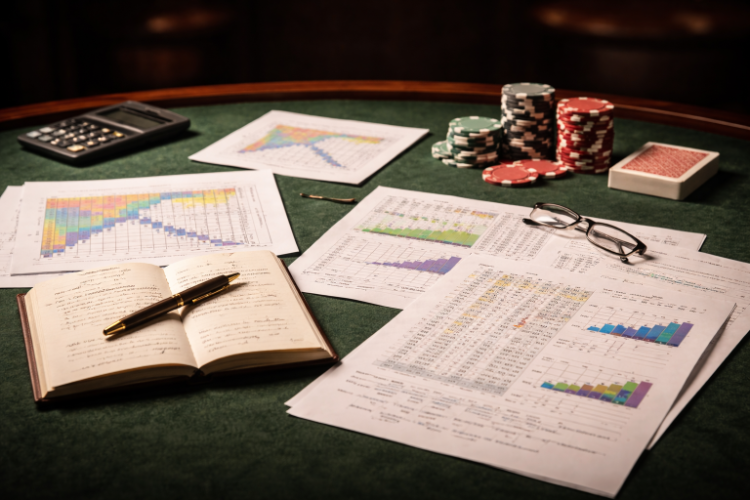
If poker skill is really about understanding and managing luck, then improving as a player isn’t about finding secret tricks or waiting for better cards. It’s about putting yourself in spots where luck has less power over your results and where good decisions actually get rewarded.
That starts with learning, but it doesn’t stop there.
Reading strategy, watching hands break down, and understanding basic odds all matter, especially for beginners. The more familiar you are with common situations, the less you’re guessing in real time. Guessing is where luck dominates. Informed decisions are where skill starts to show.
This is also where using the right resources makes a huge difference. Sites like ours exist for a reason to help players connect the dots between theory and real games. Strategy articles, breakdowns, and beginner-friendly explanations give you context for why certain plays work, not just that they work.
Tools matter just as much as content. Tracking your sessions, for example, can completely change how you see poker. It’s easy to remember bad beats and forget the times you got lucky yourself. A session tracker forces honesty. Over time, it shows whether you’re actually improving or just running hot.
Odds calculators are another underrated resource. You don’t need to become a math wizard, but seeing how often hands win in common situations builds intuition fast. Once you’ve looked at enough spots, your in-game decisions start to feel more confident not because you’re lucky, but because you’ve seen the math before.
There’s also a mental side to all of this. Players who blame everything on luck tend to stop learning. Players who understand variance accept bad runs without spiraling. Improving your emotional control won’t stop bad cards from showing up, but it will stop you from making bad decisions because of them.
The goal isn’t to remove luck from poker. That’s impossible. The goal is to play in a way where luck matters less and less the longer you sit at the table. Learn consistently, track honestly, use the right tools, and trust the process. That’s how poker skill turns randomness into long-term results.
Poker Skill or Luck Overview

So is poker skill or luck? Honestly, it’s both and that’s kind of the whole point.
Luck is always part of the game. You don’t control the cards, you don’t control the deck, and sometimes you do everything right and still lose. Anyone who’s played poker for more than a week knows that feeling.
But skill is what decides what happens after enough hands. It’s how you handle those bad runs, whether you keep making solid decisions, and whether you learn from your mistakes instead of blaming the cards. Over time, the players who understand the game better end up winning more, even though they’re dealing with the same odds as everyone else.
Poker isn’t about trying to get lucky or pretending luck doesn’t matter. It’s about accepting that it does and playing in a way where it hurts you less and helps you more.
In the short term, anything can happen. In the long run, the players who put in the work usually get paid.





Leave a Reply