
Double Board PLO Bomb Pot Calculator

By Don • Last updated January 16, 2026

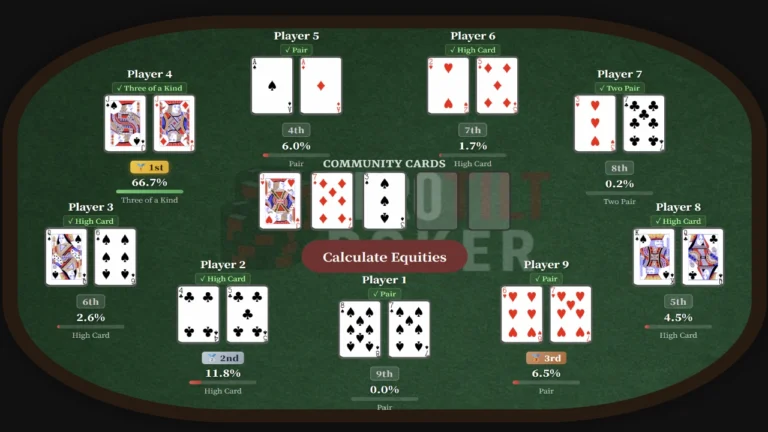
Double Board PLO Bomb Pot Calculator with equity that accounts for board interdependence. See who is winning each board, scoop and split odds, and strict outs that only include runouts that can win or tie.
Calculate Double Board PLO Bomb Pot Equity
Plug in the players, hands, and two boards to get accurate double board bomb pot equity. This calculator keeps the boards interdependent when it runs the math. You will also see who is currently ahead on each board plus strict outs.
Try out the Double Board PLO Bomb Pot Calculator below!
Board 1
Board 2
Select Cards
How to Use the Double Board PLO Bomb Pot Calculator
Use this tool to see who is currently winning on each board, what each player’s equity looks like, and which runout cards can realistically swing the hand.
Step 1: Enter the players and hands
Add each player and input their four hole cards.
Step 2: Add Board 1 and Board 2
Enter the community cards for both boards. You can run it on the flop, turn, or river. The more streets you add, the tighter and more accurate the equities become.
Step 3: Read the results
You will typically see per board equities, total equity, and who is currently ahead on each board. In bomb pots, pay attention to who can scoop versus who is mostly playing for half.
Step 4: Use the outs panel correctly
The outs panel is intentionally strict. It tries to show outs that actually matter, not cards that improve you but still lose anyway. If a player already has the current best hand on a board, outs are usually not shown for them because they are not chasing. The outs section is meant for the players who need to catch up.
How the Double Board PLO Bomb Pot Calculator Works
This calculator evaluates both boards from the same shared deck, then combines the outcomes into what bomb pot players care about: scoops, splits, and how often each player ends up with the best result on Board 1, Board 2, or both.
How double board PLO bomb pots are evaluated
Each board is scored like a normal PLO board using the best five card hand a player can make with exactly two hole cards and three board cards. The tool then looks at the combined outcome across both boards to determine how often each player scoops, splits, chops, or gets quartered.
Why the two boards are not independent
In a real double board bomb pot, both boards are dealt from the same deck. That means the unseen cards are shared. If a card appears on one board, it cannot also appear on the other. Because of that, the runouts on Board 1 and Board 2 are linked, even though they are separate boards.
Some calculators get this wrong by treating the boards as independent, basically like two separate decks. That sounds harmless, but it changes the probability space and can push equities off, especially on earlier streets or in big multiway pots. This tool keeps the boards tied to the same deck, so the percentages reflect how double board bomb pots actually work.
How the equity is calculated
The calculation method is predetermined in the background. The goal is simple: produce accurate equity while keeping the results fast enough to be useful. Depending on the spot, the tool may enumerate all valid runouts or use a high quality simulation, but in both cases it always respects the shared deck between both boards.
How the outs filtering works
The outs system aims to be practical. It is not trying to list every card that technically changes your hand. It tries to list cards that do two things:
- Actually improve your board result compared to your current best hand on that board.
- Can realistically win or tie versus the opponents after that card comes.
This prevents bloated outs lists where you improve from a weak pair to a slightly less weak pair but still get crushed by a made straight or flush.
Why outs are not shown for current leaders
If you already have the strongest hand right now on a given board, you are not drawing to improve into the lead. You are defending your lead. Showing outs for the current leader is usually noise, so the tool focuses the outs panel on players who are behind and need meaningful runout cards to catch up.
Why This Double Board Bomb Pot Calculator Is Useful
PLO bomb pots are chaotic. Everyone is in, pots are multiway, and double boards create weird incentives where second best hands get punished hard. This tool helps you make sense of the mess in a way that actually matches how bomb pots play in real life.
- Instant clarity on who is winning on each board right now.
- Equity that accounts for scoops and splits, not just one board.
- Accurate double board math that respects the shared deck, so your percentages do not drift.
- Strict outs lists that focus on cards that can swing the outcome.
- Better decision making for turn and river barrels, thin value, and bluff spots.
- Great for studying bomb pot lines you were unsure about after a session.
If you have ever thought “I feel ahead but I might be dead,” this calculator is basically made for that exact moment.
What This Double Board PLO Bomb Pot Calculator is For
This calculator is designed for players who want to understand double board PLO bomb pots at a deeper level, either during study sessions or when reviewing hands. It is especially useful for:
- Checking whether you are truly freerolling a board or just pretending you are.
- Seeing when you should shift from play for half to push for scoop.
- Spotting situations where your draw looks pretty but is dominated.
- Understanding how multiway dynamics change equity in bomb pots.
- Finding runouts that matter instead of guessing.
In short, it helps you stop relying on vibes and start relying on math, without turning everything into a textbook.
Double Board PLO Bomb Pot Strategy Tips
Bomb pots reward hands that can win big across multiple boards, not hands that look cute on one board but are fragile on the other. Here are some practical strategy tips that hold up in most double board games.
Think in scoops, not just “am I ahead”
Winning one board is nice, but the real money comes from scooping or freerolling a board while having live equity on the other. If you are only ever playing for half, you will often get stuck in thin spots where you are investing too much to win too little.
Prioritize nut draws and strong made hands
Second best flushes, weak wraps, and dominated straights get punished hard in bomb pots. Multiway action means someone shows up with the nuts a lot more often than you want to believe.
Be honest about dominated draws
A draw can look huge and still be in terrible shape if you are drawing to non nut outs. If you are chasing a straight where the nut straight is available, or you are on a flush draw that loses to higher flushes, your outs are not all clean. This is exactly why strict outs filtering matters.
Sometimes playing for half is correct
There are plenty of spots where your best route is to lock up one board and reduce variance on the other. The key is knowing when you are locking up a board for real versus when you are still vulnerable to common runouts.
Use turn and river pressure wisely
In bomb pots, people overvalue medium strength hands because everyone is in. If you have nut advantage on a board and strong scoop potential, applying pressure on turns and rivers can print. If your story relies on running perfect, slow down and pick better spots.
What is a Double Board PLO Bomb Pot?
A Special Game Mode Often Played the Hand Following a Monotone Flop, where Everyone Posts Preflop, 2 Flops are Dealt & the Pot is Split Between the Winners of Each Board
A bomb pot is a hand where every player posts an agreed amount preflop, and the hand skips the preflop action. Everyone is already in the pot, then the dealer runs the flop immediately. In PLO, bomb pots are usually played multiway, which makes equities run much closer and makes nut advantage matter even more.
A double board bomb pot means two boards are dealt at the same time. The pot is split between the winners of each board. If the same player wins both boards, they scoop. If different players win each board, they split. Ties can create chops and quarters depending on the house rules.
Double Board PLO Bomb Pot FAQ
What is a bomb pot in PLO
A bomb pot is a hand where everyone posts preflop and the action starts on the flop. In PLO, bomb pots are commonly played multiway and often include double boards.
How do you win a double board bomb pot
You win by having the best PLO hand on one board to win that half of the pot. If you win both boards, you scoop the entire pot. If different players win each board, the pot is split.
Why are my outs not showing
Most of the time, it is for one of these reasons:
- You currently have the best hand on that board, so you are not considered behind and the outs panel focuses on other players.
- The cards that improve your hand still cannot win or tie versus the opponents, so they are filtered out to avoid noisy outs lists.
- There are too few unknown cards left, so the meaningful outs count is naturally small.
Does the tool account for ties and chops
Yes. Each board is evaluated for wins and ties, and the combined outcome reflects common bomb pot realities like splits, chops, and situations where multiple players share a board result.
What does it mean to get quartered in a bomb pot
Getting quartered usually means you only receive a quarter of the total pot because one half is split between multiple players, or you tied for a board while losing the other board. It happens a lot in multiway double board games.
What is the best way to study bomb pots with this calculator
Save a few real hands from your sessions, plug them in street by street, and compare what you thought your equity was versus what it actually was. Pay special attention to dominated draws and how often safe turns are not actually safe in multiway pots.





Leave a Reply